
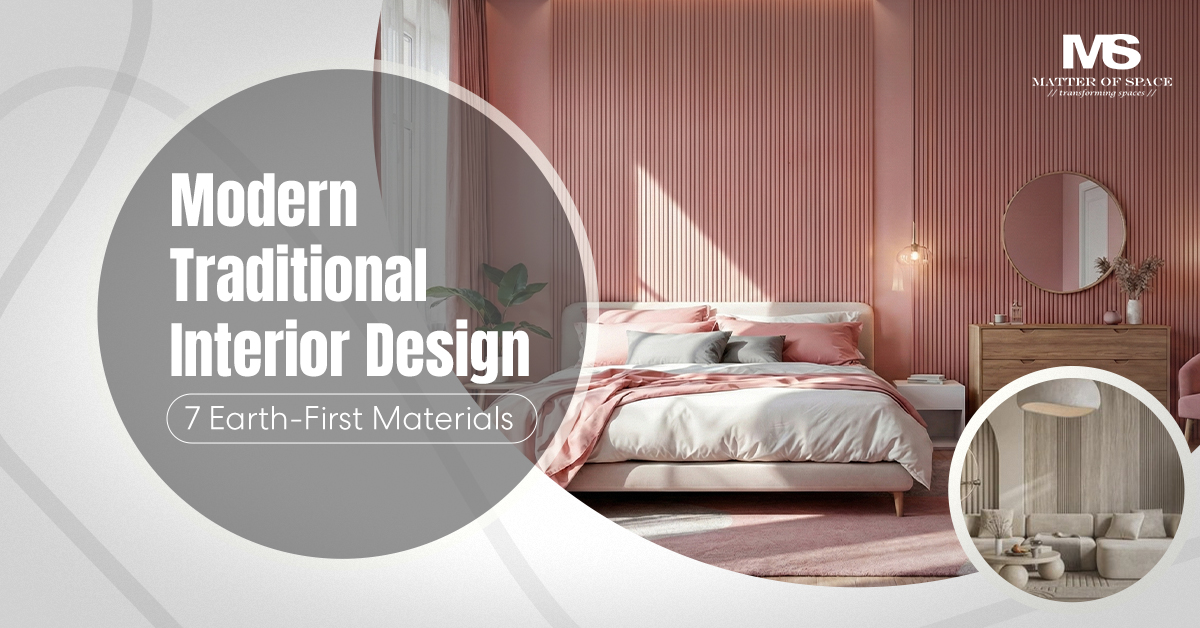
Modern Traditional Interior Design | 7 Earth-First Materials

admin
You may think that traditional materials & Indian heritage interior design is a thing of the past, but this trend is timeless.
And the quiet warmth of traditional textures, stones & fabrics always slay, and if you want to make your home alive with traditional interior design then, this piece is for you.
Learn how you can infuse Indian heritage in your modern homes & through which sustainable materials.
Tips to Infuse Indian Heritage in Traditional Interior Design Home
The following are some of the experimented methods in which Indian heritage can easily be introduced to a contemporary house without appearing like it is a museum:
Lean into Regional Craft Traditions
There are 29 provinces (States) in India, and each of them has its own craft vocabulary. Rajasthani blue pottery, Madhubani wall paintings, Kashmiri carpeted rugs woven by hand, and so on, these are not merely decorative; in fact, they have a story. The choice of one or two regional crafts and letting them anchor a room instead of everything everywhere can be picked.
Work with Earthy, Muted Palettes
It is the end of the times of stark white walls. You will have to do the palettes as haldi yellow, brick red, indigo blue, the dusty sage of old havelis. The colours make a living space alive and combine well with natural surfaces. They also react well to the changing natural lights that occur in Delhi and look better during winter afternoons, and in summer, the afternoon light changes even more.
Bring in the Jaali
The perforated screen, the jaali, is one of India’s most functional design masterstrokes. It regulates light, gives privacy and forms beautiful shadows. It can be carved wood, stone, or even laser-cut metal on old-fashioned patterns, but a jaali immediately puts a modern house in the history of Indian design.
Go for Courtyards, Even Indoors
The Indian chowk (inner yard) was traditional about the light, the air circulation and the community. In the current apartments, you can replicate this with a double high space, skylights or a garden nook inside.
Even the little fountain by the door is a reflection of that antique courtyard rationale.
Layer Handloom Textiles Thoughtfully
The bridging between old and new is mostly done by block-printed cushion covers, handwoven cotton durries, ikat curtains, and handloom textiles. They are also one of the most environmentally-friendly sources of material that you can choose, as they provide weavers with jobs and do not involve the use of synthetic manufacturing.
It is not a concept of reproducing a heritage house. It is to give some substance to what these places were alive with, and render it, in material and craft, into standing to your life at this moment.
7 Earth-First Sustainable Materials for Traditional Interiors
All of these are carefully selected materials so that they are climate-appropriate in the Delhi-NCR area, where you are going to be fighting with hot, dry summer, humid monsoon, and cold winter. Not only are they beautiful, but also smart.
#1: Terracotta
Indian design has embraced Terracotta since the Harappan people, and it has not been out of favour. Fired clay, which is used as floor tiles, wall cladding, decorative panels and even a ceiling module, has a natural propensity to control temperature. During the hot seasons of Delhi, tarmac holding summers, terracotta floors remain comparatively cooler to tread compared to marble or polished granite.
Best used for: Flooring, feature walls, kitchen backsplash, and decoration accessories.
Why it works in Delhi: Thermal insulation and the cooling passive effect.
Design tip: Combine with brass fixtures and natural plaster walls to give the house a warm, welcoming appearance.
#2: Rammed Earth
Rammed earth is a blend of soil, sand, gravel and clay that is pressed into a wall. This luxury material is experiencing a huge renaissance in the renovation of sustainable materials in homes in India.
Best used for: Boundary walls, feature walls, statement interior walls.
Why it works in Delhi: Heat captured by its thermal mass is stored up during the day and gives it back gradually at night, the natural kind of air conditioning.
Design tip: The rammed Earth wall pattern in the form of layers reveals a gorgeous appearance when it is not covered.
#3: Bamboo
Bamboo propagates within 3-5 years, unlike the 50 and above of hardwood timber. It is lightweight, tensile and surprisingly versatile for interior use. This is the most renewable of all the natural building materials in modern homes.
Best used for: Furniture, ceiling panelling, screens to partitions, flooring, ornamental accents.
Why it works in Delhi: Light and permeable; it will not check so drastically like some hardwoods when the seasons are changing.
Design tip: Tropical light with bamboo screens is a gorgeous combination that creates a sumptuous layer of organic interior. Consult an interior designer in Gurgaon who will not give you a catalogue but will assist you in finding the correct materials to use in your house.
#4: Lime Plaster (Chuna)
Forget POP and gypsum boards. Lime plaster, which was used in old Delhi havelis and Mughal buildings, is also returning to its rightful place. It is breathable, anti-microbial and has a gorgeous patina that forms as time passes.
Best used for: Wall decorations, arches, mouldings.
Why it works in Delhi: Prevents dampness on walls, and makes it less damp during the monsoon.
Design tip: One of the cheapest and most frequently used methods of adding some personality to any room is to provide a limewashed accent wall in either terracotta or ochre.
#5: Reclaimed Wood
Railway sleepers, old doors, used beams, reclaimed and used wood bring along history in their grain. Eco interior design Gurgaon studios have been using it in all aspects, such as the dining table, up to the feature shelving.
Best used for: Dining tables, console units, shelving, beams on the ceilings, and headboards.
Why it works in Delhi: Old pieces of wood are already acclimatised and less likely to expand and shrink with the changing of the seasons.
Design tip: Combine old wood with new steel or glass to create a classic and modern contrast which seems natural.
#6: Local Stone (Dholpur, Agra, Jaisalmer)
The quarries of India present us with some of the prettiest stone in the world, and a good deal of it is in a few hundred kilometres of Delhi. Mughal and Rajput design traditions are bridged directly through such materials as dholpur red sandstone, Agra red stone, and creamy Jaisalmer limestone.
Best used for: Flooring, stairs and exterior cladding, bathroom walls, jaali screens.
Why it works in Delhi: Quarried locally (low footprint in transport), naturally cool, inconceivably seasonally durable.
Design tip: In one of the living rooms, the stone flooring of Jaisalmer combined with the white walls and dark wood furniture is easily classy.
Read Also : Unique Wooden Mandir Designs for Your Modern Home
#7: Natural Jute, Cane & Handloom Textiles
Often overlooked as a ‘material’, textiles define the sensory character of a home. Jute rugs, cane-woven furniture, and handloom upholstery are some of the most accessible and lowest-carbon choices in home design.
Best used for: Rugs, windows, upholster, wall, pendant lamp.
Why it works in Delhi: Natural fibres are known to be breathers and this helps to create a cooler inside environment.
Design tip: A large hand-knotted jute rug anchors a living room and grounds all other materials beautifully
Read Also : Stylish Wall Colour-Combination Ideas for Home Interiors
Why Pick Matter of Space for Your Traditional Interior Design?
You are a homeowner in Delhi-Gurgaon and need interior designers who can think of the overlap between luxury, sustainability and cultural identity. We are here to make your dream come true.
Being professional interior designers in Gurugram, we have an in-depth knowledge of the Indian tradition of design and current spatial planning.
At Matter of Space, our interior designers approach every brief with the same question:
How does this space serve the people living in it?
How does it honour the planet they live on?
Our curated use of natural materials, local artisan collaborations, and climate-sensitive design strategies makes us one of the generic turnkey studios.
Final Thoughts
The home you deserve isn’t built on synthetic shortcuts. It’s built on clay and limestone, old wood and woven cotton, materials that have served Indian homes for centuries and are smarter than anything manufactured in the last fifty years.
As awareness around eco-friendly interior design in Gurgaon continues to grow, the good news is you no longer have to choose between a beautiful home and a responsible one.
Let your home grow from the earth up.
